b‑Ga2O3 is well established as an ultra–wide-bandgap semiconductor with a high breakdown field, making it highly suitable for high-voltage, energy-efficient devices. Alloying with aluminium to form β-(AlxGa1-x)2O3 enables further bandgap widening. However, the growth of films with high aluminium content is challenging due to lattice mismatch with conventional b‑Ga2O3 substrates.
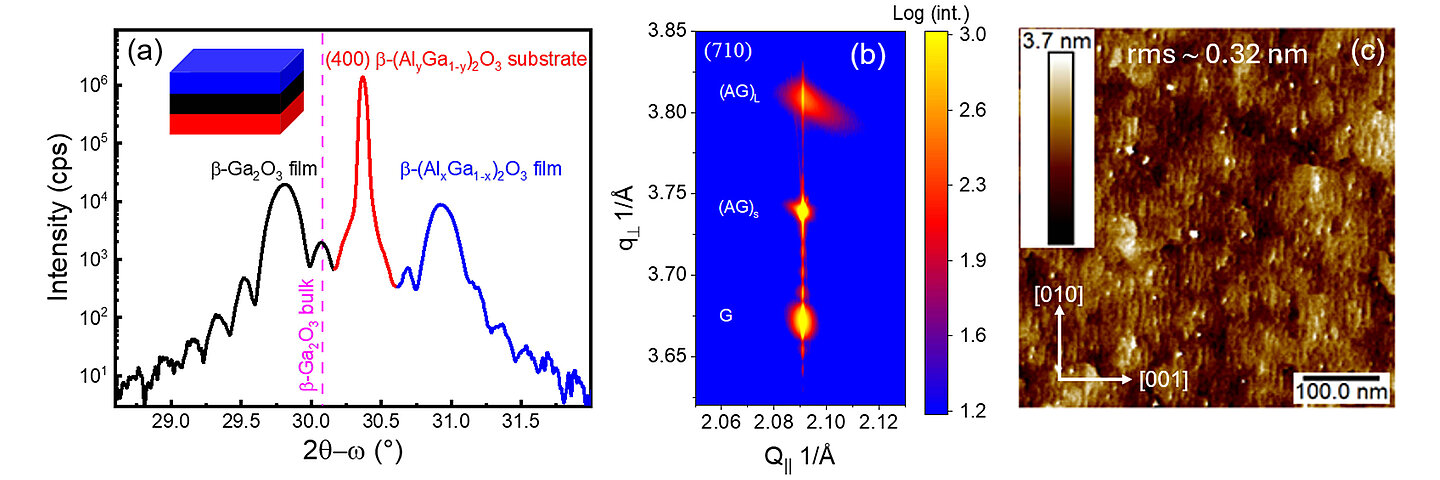
β-(AlyGa1-y)2O3 substrates provided by the Leibniz-Institut für Kristallzüchtung (IKZ) represent a promising approach to mitigating this issue. Researchers at the IKZ have demonstrated the successful growth of β-(AlxGa1-x)2O3 thin films on β-(AlyGa1-y)2O3 substrates (y = 0.24), achieving aluminium compositions as high as 55% using metalorganic vapor phase epitaxy (MOVPE).
Moreover, the resulting β-(AlxGa1-x)2O3/b‑Ga2O3 heterostructures exhibit high crystalline quality and coherent multilayer growth. The realization of high Al content β-phase films with excellent structural integrity represents a significant step forward, overcoming a longstanding materials limitation. This progress opens new opportunities for the development of advanced wide-bandgap semiconductor devices, particularly in high-power and high-frequency applications, and may play a key role in the future evolution of heterojunction-based technologies.
We warmly congratulate the team on this scientific achievement.
The co-authors are: Arub Akhtar, Ta-Shun Chou, Zbigniew Galazka, Martin Schmidbauer, Thilo Remmele, Martin Albrecht, Andreas Fiedler, and Andreas Popp.
Publication: https://doi.org/10.1116/6.0005233
Contact
Leibniz-Institut für Kristallzüchtung (IKZ)
Dr. Saud Bin Anooz
Phone: +49 (0) 30 / 246 499 309
Email