International expertise from research and industry
Aluminum nitride (AlN) is considered a promising semiconductor material for high-performance electronic devices and light sources in the deep ultraviolet spectral range. The development of these technologies places high demands on material quality, fabrication, and integration into electronic and photonic devices.
The symposium provided a platform for scientific exchange, bringing together different perspectives on current scientific advances and remaining challenges. Researchers from leading European universities and research institutions, as well as representatives from the semiconductor industry, discussed new developments and examined the requirements for translating research findings into technological applications.
In the session focused on power and high-frequency electronics, Thomas Straubinger (IKZ), Mervi Paulasto-Kröckel (Aalto University), Rüdiger Quay (Fraunhofer IAF), Oliver Hilt (Ferdinand Braun Institute), and Martin Kuball (University of Bristol) presented recent research findings on AlN and other ultra-wide-bandgap semiconductor materials. The presentations highlighted both the potential of these materials for future electronic devices and the scientific and technological challenges involved in bringing them into practical use.
The second session focused on photonics and optoelectronics. Martin Strassburg (ams OSRAM), Åsa Haglund (Chalmers University of Technology), Michael Kneissl (TU Berlin / Ferdinand Braun Institute), and Bernd Witzigmann (FAU Erlangen-Nuremberg) presented advances in the development of UV lasers, UV-C LEDs, and other optoelectronic devices.
IKZ International Fellowship 2026 for Andreas Waag
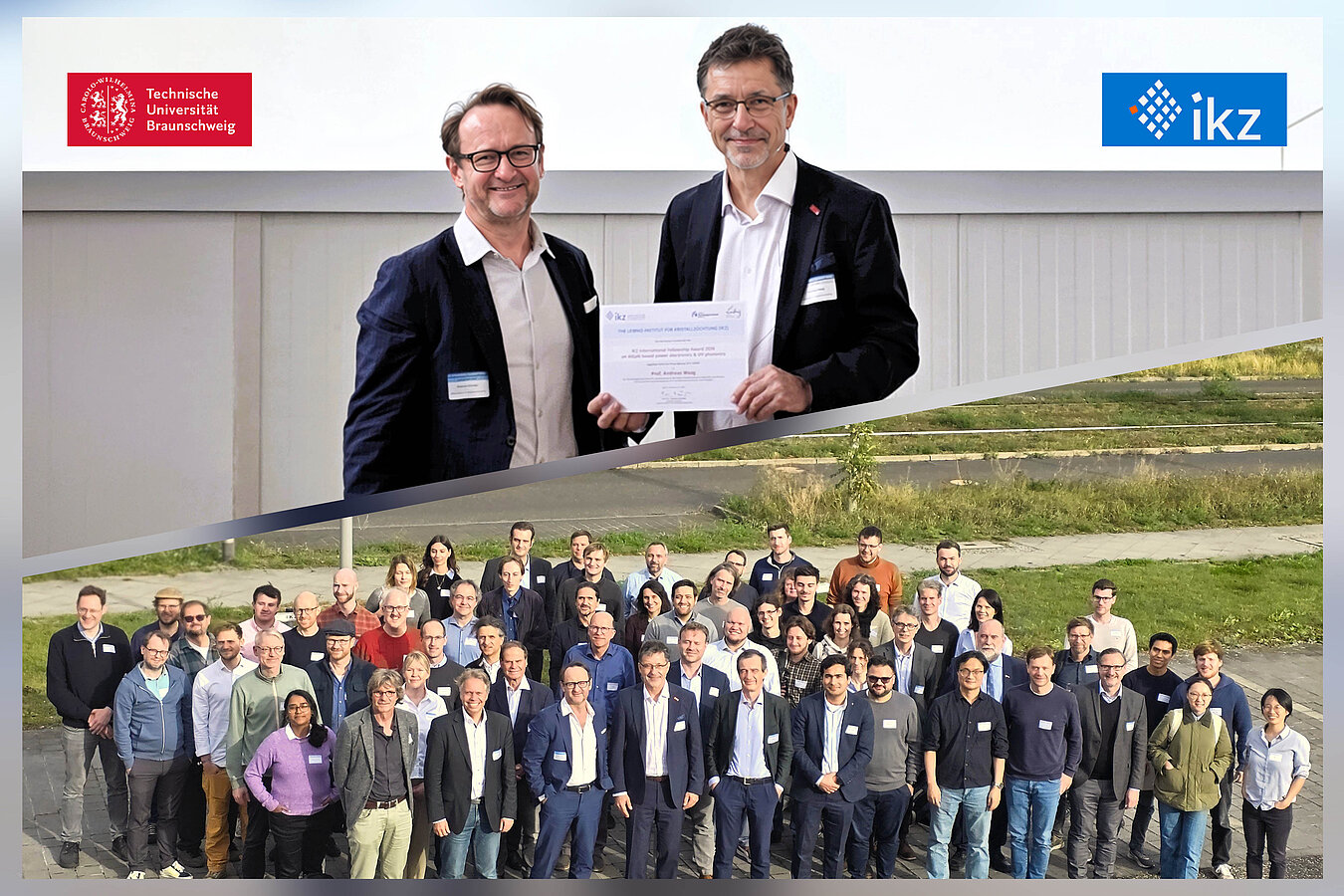
A highlight of the symposium was the award of the IKZ International Fellowship 2026 to Prof. Dr. Andreas Waag. With this award, the IKZ recognized an internationally renowned scientist who has played a key role in shaping research on nitride semiconductors for many years. In his Fellowship lecture, “Nitride Semiconductors and Their Future Role in Quantum Technology, Photonics, and Microelectronics,” Andreas Waag explored current developments in nitride semiconductor research and their potential impact on quantum technologies, photonics, and microelectronics. His lecture broadened the symposium’s perspective by highlighting the potential of nitride semiconductors across several emerging technologies.
Nitride technology and European technological sovereignty
Beyond scientific and technological issues, the symposium also addressed the strategic importance of nitride technology for Germany and Europe. The scientific program concluded with a panel discussion on technological sovereignty. Following a presentation by Dirk Ziemann (Federal Ministry of Research, Technology, and Space, BMFTR) on Germany’s High-Tech Agenda, Andreas Waag moderated the discussion on the significance of nitride technology for European semiconductor research and industry. A central question was how scientific findings can be translated into technological innovations and industrial applications. The exchange highlighted the importance of scientific excellence, advanced research infrastructure, and close collaboration between academia, industry, and policymakers in realizing the long-term potential of new semiconductor materials.
About Prof. Dr. Andreas Waag
Andreas Waag has been a professor of semiconductor engineering at the Technical University of Braunschweig since 2003. His research focuses primarily on the physics and technology of nitride semiconductors and their use in photonic and optoelectronic devices. Other research interests include micro-LEDs, the control of light at the nanoscale, and quantum and nanometrology.
At TU Braunschweig, Waag is also actively involved in interdisciplinary research collaborations at the intersection of semiconductor, quantum, and nanotechnology. In 2026, he handed over the role of TU Braunschweig’s spokesperson within the QuantumFrontiers Cluster of Excellence to Prof. Dr. Stefanie Kroker. He continues to contribute his scientific expertise to strategic research initiatives, including the Nitride Technology Center.
Contact:
Leibniz-Institut für Kristallzüchtung (IKZ)
Group leader Aluminum Nitride Prototyping
Application Science
Phone: +49 (0) 30 / 246 499 602
Email: carsten.hartmannikz-berlin.de
Press and Public Relations
Stefanie Grüber
Phone: +49 (0) 30 / 246 499 126
Email: stefanie.grueberikz-berlin.de
Web: https://www.ikz-berlin.de/en